

No price development information for this product.
Product unavailable
This product is end of life or currently not available.
This product is end of life or currently not available.
Specifications
Description
Store availability
Delivery
Price development
| EAN | 887758291085 |
| Warranty | 1 year |
| Source: Icecat.biz | |
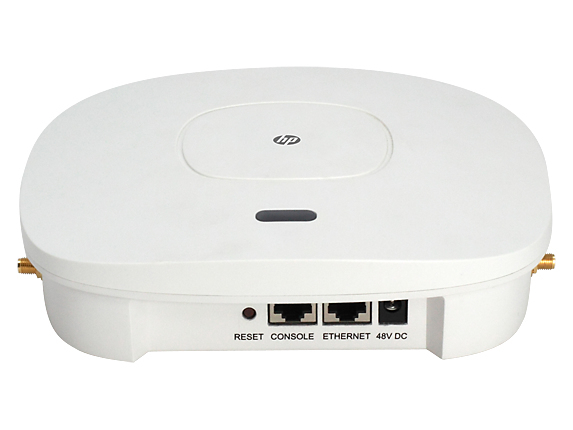
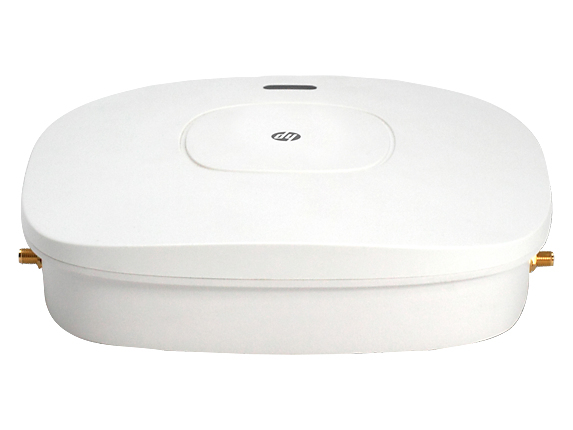
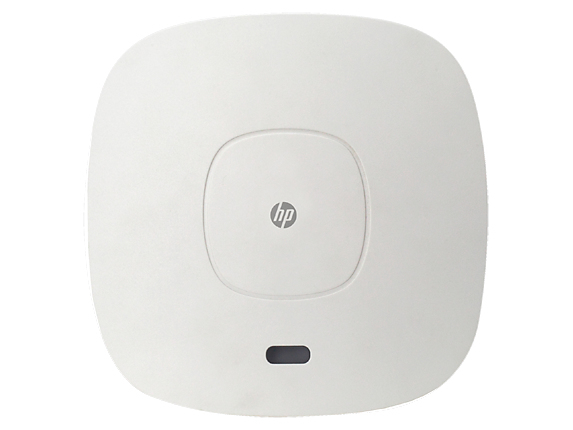
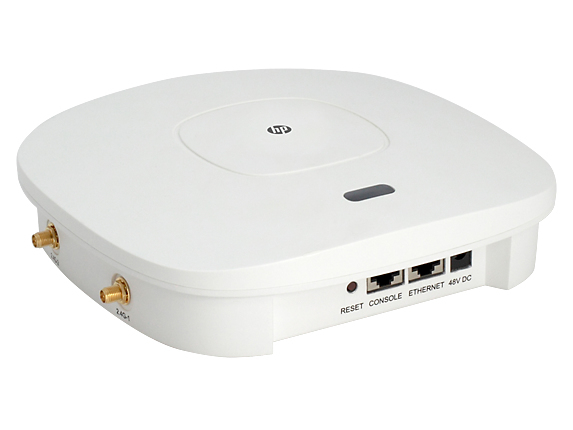
- Working in unison with HP controllers, the HP 425 802.11n Dual Radio Access Point Series delivers high-performance networking solutions. The enhanced controller architecture scales to IEEE 802.11n without requiring a controller replacement.
- The controller provides advanced radio resource management (RRM), including client load balancing and interference mitigation. The HP wireless controllers support a fast-roaming capability--an important feature, especially for VoIP communications.
- The HP 425 access point works in managed mode with an HP wireless LAN controller. The access points provide RF spectrum analysis with detection and classification of non-IEEE 802.11 interference, and have the ability to automatically avoid interference.
- Wireless security is comprehensive with integrated wireless IDS and support for internal and external authentication, authorization, and accounting (AAA) servers; built-in stateful firewall; per-user VLAN mapping; and authentication. In addition to working with the HP MSM controllers, the access points work with the new HP 10500/7500 20G Unified Wired-WLAN Module, the HP 800 Series Unified Wired-WLAN Switch, and the HP WX5002/5004 wireless controllers.
Management
- Wi-Fi Clear Connect: provides a system-wide approach to improving WLAN reliability by proactively determining and adjusting to changing RF conditions; helps optimize WLAN performance by detecting interference from Wi-Fi and non-Wi-Fi sources using spectrum analysis capabilities built into the access points, identifying rogue activity, and making decisions at a system-wide level
- Advanced radio resource management: Automatic radio power adjustments: include real-time power adjustments based on changingenvironmental conditions and signal coverage adjustment. Automatic radio channel: provides intelligent channel switching and real-time Interferencedetection. Intelligent client load balancing: determines number of clients across neighboring APs and adjustsclient allocation to balance the load. Airtime fairness: provides equal RF transmission time for wireless clients.
- Spectrum analysis : Power/frequency spectrum analysis: measures noise from IEEE 802.11 remote sources. Signal detection/classification: identifies source of RF interference, for example, Bluetooth®, cordless phones, and microwave ovens. Evaluation of channel quality: helps detect severe channel degradation and improves thereporting of poor RF performance.
- Integrated IDS: detects and locates unknown and rogue devices (see controller data sheet for details)
- Access point management: provides secure Web browser (SSL and VPN), command-line interface, SNMP v2c, SNMP v3, MIB-II with traps, and RADIUS Authentication Client MIB (RFC 2618); offers embedded HTML management tool with secure access (SSL and VPN); implements scheduled configuration and firmware upgrades from a central controller
Quality of Service (QoS)
- Rate limiting: supports per-wireless client ingress-enforced maximums andper-wireless client, per-queue guaranteed minimums
- Centralized traffic: maintains Layer 2 and Layer 3 QoS settings when using centralized traffic or guest access
- IEEE 802.1p prioritization: delivers data to devices based on the priority and type of traffic
- Wireless: L2/L3/L4 classification: IEEE 802.1p VLAN priority, SpectraLink SVP, and DiffServ. Virtual Service Community (VSC): assign Wi-Fi MultiMedia (WMM), IEEE 802.11e EDCF, and Service-Aware priority . VoIP call capacity: supports 12 active calls per radio, maximum.
- SpectraLink Voice Priority (SVP) support: prioritizes SpectraLink voice IP packets sent from a SpectraLink NetLink SVP server to SpectraLink wireless voice handsets to help ensure excellent voice quality
Connectivity
- IEEE 802.3af Power over Ethernet (PoE) support: simplifies deployment and dramatically reduces installation costs by helping to eliminate the time and cost involved in supplying local power at each access point location
- Local power option: offers 48V DC power connector for use with an optional power supply when PoE is not available
- Auto-MDIX: adjusts automatically for straight-through or crossover cables on the Ethernet interface
- Console port: aids problem resolution
Mobility
- Bandsteering: redirects 5 GHz-capable clients automatically to the less-congested 5 GHz spectrum
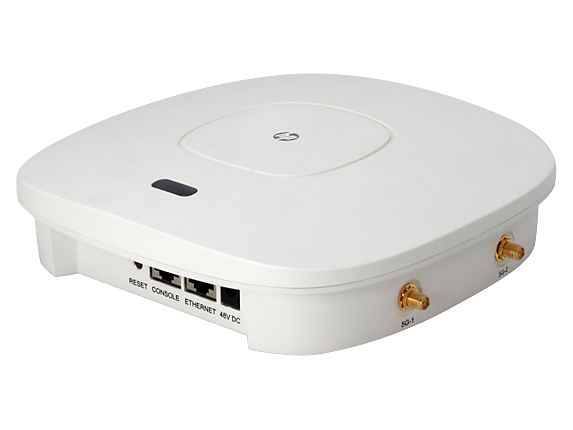
- HP 425 Antenna: Embedded antenna: provides excellent coverage through use of embedded high-gain antennas (4 dBi antenna at 2.4 GHz and 5 dBi antenna at 5 GHz); no need for the added cost of external antennas. Optional external antenna: includes four indoor RP-SMA connectors for use with optional external antennas.
- Anywhere, anytime wireless coverage: dual-radio IEEE 802.11b/g/n and 802.11a/n access point; per-radio software-selectable configuration of frequency bands; self-healing, self-optimizing local mesh that extends network availability; Wi-Fi Alliance Certifications for interoperability with all IEEE 802.11a/b/g/n client devices; and IEEE 802.3af PoE
- Medical standards: meets the European EN60601-1-2 standard for healthcare
- Virtual Service Communities (VSCs): includes up to 16 SSIDs per radio, each with unique MAC address and configurable SSID broadcasts; individual security and QoS profiles per VSC; configurable DTIM and minimum data rate per VSC; VSCs that can be mapped to separate IEEE 802.1Q VLANs; WMM and/or WMM-PS; a security filter; and an IP filter
- The controller provides advanced radio resource management (RRM), including client load balancing and interference mitigation. The HP wireless controllers support a fast-roaming capability--an important feature, especially for VoIP communications.
- The HP 425 access point works in managed mode with an HP wireless LAN controller. The access points provide RF spectrum analysis with detection and classification of non-IEEE 802.11 interference, and have the ability to automatically avoid interference.
- Wireless security is comprehensive with integrated wireless IDS and support for internal and external authentication, authorization, and accounting (AAA) servers; built-in stateful firewall; per-user VLAN mapping; and authentication. In addition to working with the HP MSM controllers, the access points work with the new HP 10500/7500 20G Unified Wired-WLAN Module, the HP 800 Series Unified Wired-WLAN Switch, and the HP WX5002/5004 wireless controllers.
Management
- Wi-Fi Clear Connect: provides a system-wide approach to improving WLAN reliability by proactively determining and adjusting to changing RF conditions; helps optimize WLAN performance by detecting interference from Wi-Fi and non-Wi-Fi sources using spectrum analysis capabilities built into the access points, identifying rogue activity, and making decisions at a system-wide level
- Advanced radio resource management: Automatic radio power adjustments: include real-time power adjustments based on changingenvironmental conditions and signal coverage adjustment. Automatic radio channel: provides intelligent channel switching and real-time Interferencedetection. Intelligent client load balancing: determines number of clients across neighboring APs and adjustsclient allocation to balance the load. Airtime fairness: provides equal RF transmission time for wireless clients.
- Spectrum analysis : Power/frequency spectrum analysis: measures noise from IEEE 802.11 remote sources. Signal detection/classification: identifies source of RF interference, for example, Bluetooth®, cordless phones, and microwave ovens. Evaluation of channel quality: helps detect severe channel degradation and improves thereporting of poor RF performance.
- Integrated IDS: detects and locates unknown and rogue devices (see controller data sheet for details)
- Access point management: provides secure Web browser (SSL and VPN), command-line interface, SNMP v2c, SNMP v3, MIB-II with traps, and RADIUS Authentication Client MIB (RFC 2618); offers embedded HTML management tool with secure access (SSL and VPN); implements scheduled configuration and firmware upgrades from a central controller
Quality of Service (QoS)
- Rate limiting: supports per-wireless client ingress-enforced maximums andper-wireless client, per-queue guaranteed minimums
- Centralized traffic: maintains Layer 2 and Layer 3 QoS settings when using centralized traffic or guest access
- IEEE 802.1p prioritization: delivers data to devices based on the priority and type of traffic
- Wireless: L2/L3/L4 classification: IEEE 802.1p VLAN priority, SpectraLink SVP, and DiffServ. Virtual Service Community (VSC): assign Wi-Fi MultiMedia (WMM), IEEE 802.11e EDCF, and Service-Aware priority . VoIP call capacity: supports 12 active calls per radio, maximum.
- SpectraLink Voice Priority (SVP) support: prioritizes SpectraLink voice IP packets sent from a SpectraLink NetLink SVP server to SpectraLink wireless voice handsets to help ensure excellent voice quality
Connectivity
- IEEE 802.3af Power over Ethernet (PoE) support: simplifies deployment and dramatically reduces installation costs by helping to eliminate the time and cost involved in supplying local power at each access point location
- Local power option: offers 48V DC power connector for use with an optional power supply when PoE is not available
- Auto-MDIX: adjusts automatically for straight-through or crossover cables on the Ethernet interface
- Console port: aids problem resolution
Mobility
- Bandsteering: redirects 5 GHz-capable clients automatically to the less-congested 5 GHz spectrum
- HP 425 Antenna: Embedded antenna: provides excellent coverage through use of embedded high-gain antennas (4 dBi antenna at 2.4 GHz and 5 dBi antenna at 5 GHz); no need for the added cost of external antennas. Optional external antenna: includes four indoor RP-SMA connectors for use with optional external antennas.
- Anywhere, anytime wireless coverage: dual-radio IEEE 802.11b/g/n and 802.11a/n access point; per-radio software-selectable configuration of frequency bands; self-healing, self-optimizing local mesh that extends network availability; Wi-Fi Alliance Certifications for interoperability with all IEEE 802.11a/b/g/n client devices; and IEEE 802.3af PoE
- Medical standards: meets the European EN60601-1-2 standard for healthcare
- Virtual Service Communities (VSCs): includes up to 16 SSIDs per radio, each with unique MAC address and configurable SSID broadcasts; individual security and QoS profiles per VSC; configurable DTIM and minimum data rate per VSC; VSCs that can be mapped to separate IEEE 802.1Q VLANs; WMM and/or WMM-PS; a security filter; and an IP filter
Multitronic Vaasa: 0 pcs
Estimated delivery: No delivery info
Estimated delivery: No delivery info
Today: 10:00 - 18:00
Multitronic Pietarsaari: 0 pcs
Estimated delivery: No delivery info
Estimated delivery: No delivery info
Today: 09:00 - 17:00
Multitronic Jyväskylä: 0 pcs
Estimated delivery: No delivery info
Estimated delivery: No delivery info
Today: 10:00 - 17:00
Multitronic Lappeenranta: 0 pcs
Estimated delivery: No delivery info
Estimated delivery: No delivery info
Today: 10:00 - 18:00
Multitronic Mariehamn: 0 pcs
Estimated delivery: No delivery info
Estimated delivery: No delivery info
Today: 11:00 - 17:00
The above technical details are for reference only and may change without notice. We reserve the right to correct printing errors and use illustrations for guidance. Some text may be auto-generated or machine-translated, which could lead to inaccuracies.